
Actualité
Reconstruction of Louis XVI’s bed at the Château de Versailles : Interview with Charles Boulnois, founder of Atelier Boulnois and Meilleur Ouvrier de France

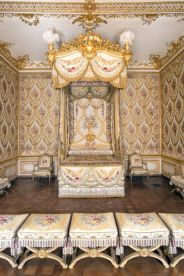
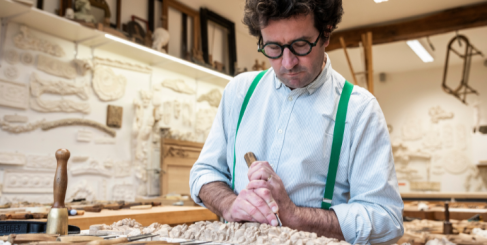
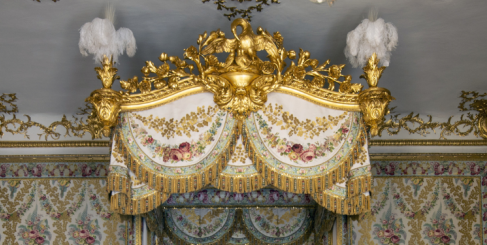
Reconstructing a royal bed from a single period invoice, with no visual representation, was the challenge taken on by Atelier Boulnois for the bedroom of the King’s private apartment at the Château de Versailles. Charles Boulnois, founder of the workshop and Meilleur Ouvrier de France, reflects on this singular project…
The bed of King Louis XVI and his “Impériale” has now regained its full splendour. How was the excellence of Atelier Boulnois’s cabinetmaking and wood carving craftsmanship put at the service of this unique project?
Charles Boulnois: In this project, the goal was not to demonstrate craftsmanship, but to put it at the service of the most accurate reconstruction possible.
We started from a single source, with no visual representation, which required a particularly precise interpretative approach. We had to use Babel’s ornamental vocabulary to rediscover the spirit of the 18th century, relying both on written records, analogical references, and our knowledge of historical styles.
Every detail must find its rightful place within a coherent and balanced whole. This is not solitary work; it is part of a dialogue with other forms of expertise, to ensure accuracy from design through to execution.
Atelier Boulnois has contributed to numerous exceptional heritage projects. What makes this reconstruction particularly emblematic for you and your team?
C.B: Every heritage project is unique, but this one is especially so because of its starting point. We had no representation of the bed, only an historical invoice.
This requires a highly developed interpretative process, where one must achieve compositional accuracy without ever over-interpreting.
What makes it emblematic for us is precisely this balance: remaining faithful to a spirit without a direct model, relying on knowledge of styles, techniques, and close collective work.
It is a project that carries significant personal responsibility for me.
Atelier Boulnois oversees everything from design to full execution. How was this end-to-end mastery deployed to bring the royal bed back to life?
C.B: On this project, project management was structured from the earliest study phases. Starting from a precise but non-visual document, we had to structure the project, define its stages, and coordinate the various areas of expertise involved.
Our role was to ensure continuity between design, development, and execution, maintaining coherence at every stage.
This approach allows us to anticipate constraints, adjust decisions during fabrication, and ensure faithful execution aligned with the original intent. It is this global control of the project, from start to finish, that makes it possible to restore such a complex piece.
Reconstructing an object of this complexity involves multiple crafts. How did you coordinate artisans and experts to guarantee accuracy and quality in every detail?
C.B: A project like this indeed relies on multiple crafts, and the challenge is to bring them together in a unified direction.
Coordination began very early, during the study phase, in order to define a shared framework and ensure continuity between design, production, and execution.
Each contributor brings their own expertise, but everything is collectively refined through regular exchanges to guarantee accuracy. Our role was to maintain this continuity throughout the project, ensuring smooth communication with the Château’s conservation team and a consistently high level of precision through to final completion.
In reconstructions of this importance, your role goes beyond fabrication. Can you explain how you supported the clients and ensured overall coherence of the project?
C.B: Indeed, in this type of project, the role goes far beyond fabrication. It involves supporting the clients from the earliest stages, providing technical expertise and stylistic knowledge to best translate the original intent.
We engage in constant dialogue to adjust decisions, anticipate constraints, and ensure overall coherence.
This continuity, from design through to execution, makes it possible to maintain a clear direction throughout the project and achieve a result that is both conceptually sound and aesthetically precise.