
Actualité
La Loo & Lou Gallery, Paris, presents a monographic exhibition by Pierre-Luc Poujol, “Franchir le visible”
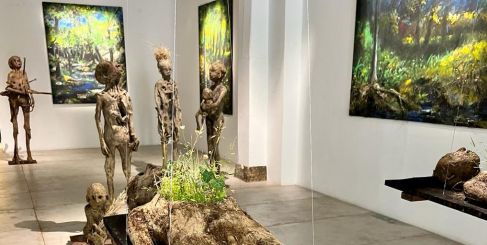
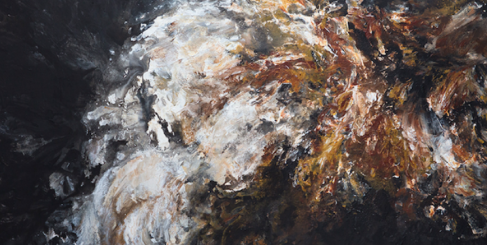
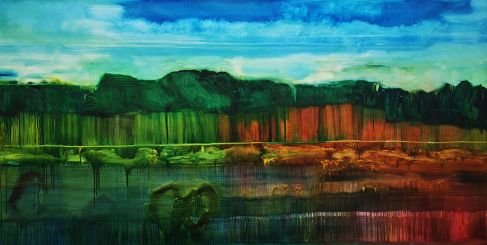
On the occasion of his second solo exhibition at Loo & Lou Gallery, Franchir le visible (from May 6 to June 17), Pierre-Luc Poujol continues a practice deeply rooted in the living world, where painting does not merely represent nature but becomes a site of activation.
His work is developed through a direct relationship with materials: ashes, plant fragments, wood, and charcoal are collected, transformed, and then reintegrated into the pictorial surface. The gesture, shaped by memory and instability, produces a fragile form of inscription in time, where each work appears as a layer, a sensitive deposit arising from a constant negotiation between intention and accident.
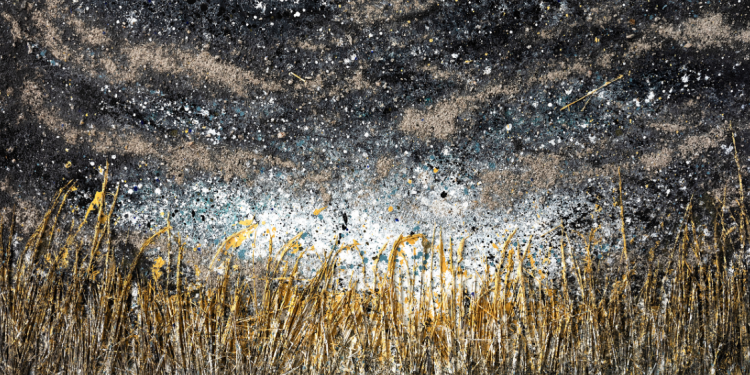
With the series “Lisières”, presented in the exhibition, the artist explores a space of tension: the threshold between order and chaos, figuration and abstraction, appearance and disappearance. Dry grasses, thistles, and ashes are incorporated into the canvas as active remnants, giving the material an almost organic dimension. Light, rather than coming from outside, seems to emerge from this very density, revealing a subterranean vitality.
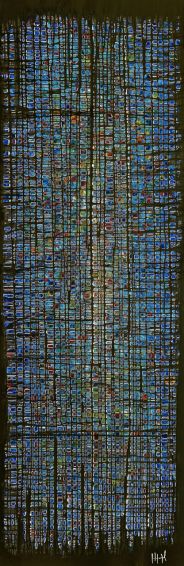
Continuing this exploration, in the series “Between the lines”, Pierre-Luc Poujol approaches bark as a true system of inscription, a language in itself. Through a dripping technique turned into writing, he brings forth a network of lines and tensions where painting acts as a revealer of strata, allowing the silent and condensed memory of the living world to emerge within abstraction.
Each piece in the exhibition thus functions as a fragment of an ecosystem, an archaeology of the living that reveals a beauty both raw and essential — that of a fragile world in constant recomposition.
A recognized figure on the French and international art scene, Pierre-Luc Poujol has exhibited in several museums, notably at the Musée Paul Valéry in Sète in 2020 and again in 2024. He has also received prestigious awards, including the UNESCO International Prize (2000) and the “Art et Nature” Prize from the Rampp Foundation (2025).
Loo & Lou Gallery